Is COVID-19 an “Ordinary Flu” That Benefits Politicians? Perception of Pandemic Disinformation in Latvia

Alise Tifentale, Anda Rožukalne, and Sandra Murinska. “Is COVID-19 an “Ordinary Flu” That Benefits Politicians? Perception of Pandemic Disinformation in Latvia.” Communication Today 12, no. 2 (2021): 68-83. https://communicationtoday.sk/volume-12-2021/

Abstract:

This study examines society's susceptibility to COVID-19-related disinformation in Latvia, linking it to self-evaluation of the perceived COVID-19 health risks. The main research questions are: "How do Latvians experience disinformation about COVID-19?"; "How does this experience relate to different degrees of perceived disease risks?". A nationally representative survey was conducted in September 2020, reaching 1,013 of Latvia's residents aged 18 to 75. More than half of the respondents (54%) have encountered misleading or false information; 30% thought that "the COVID-19-related chaos is beneficial to politicians", while 17% believed that "COVID-19 is like flu". Respondents with a higher level of education and more active media usage habits are more likely to recognise disinformation about COVID-19. Moreover, this skill is linked to a higher degree of perceived threat of the disease. Yet, those who rate their risk of disease as very high, alongside those who rate their risk of disease as low and unreal, are 'infodemically' vulnerable-more susceptible to disinformation, false news, and conspiracy theories. Recommendations to communicators about curbing the diffusion of disinformation and diminishing its impact are provided.

Download article pdf here

This article is one of the deliverables in the research project, Life with COVID-19: Evaluation of overcoming the coronavirus crisis in Latvia and recommendations for societal resilience in the future (VPP-COVID-2020/1-0013) that was carried out from June 2020 to March 2021, led by Alise Tifentale. The project was carried out by a consortium of five Latvian research institutions that won a nation-wide competition to implement a State Research Program funded project in social sciences. Read more about the project here: http://www.alisetifentale.net/research-blog-at/rsu-research-completed

Click on the image below to download the article pdf:

Click on any of the two images below to download the Editorial and Table of Contents of the journal (two pages in one pdf):

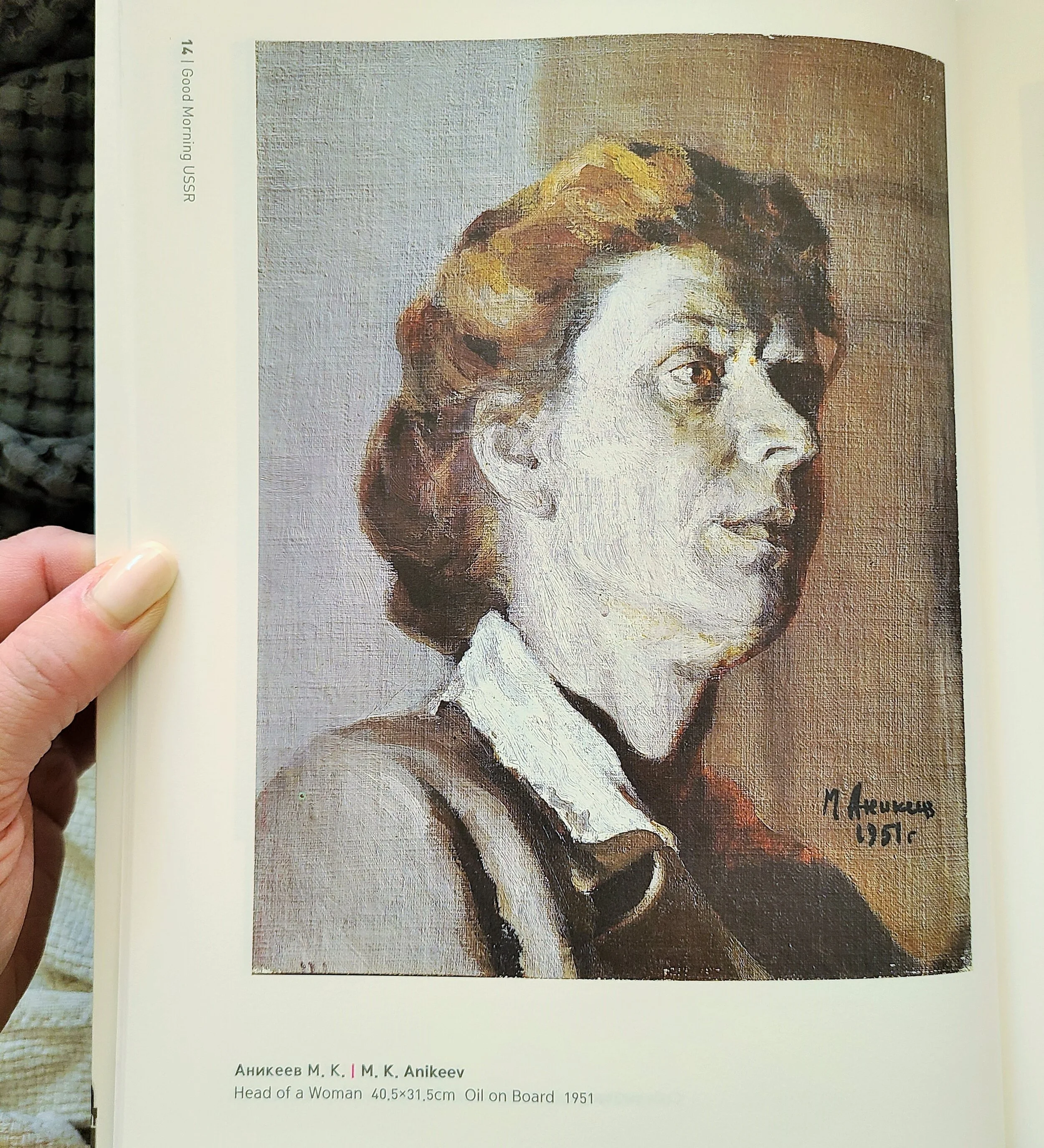
The Lesser Known Romantic Side of Soviet Art

Tifentale, Alise. “The Lesser Known Romantic Side of Soviet Art.” In Good Morning USSR (exh. cat.), Seoul: NAMA Gallery, mM Art Center, 2021.

The essay is published in Korean and English. The exhibition “Good Morning USSR” took place at the NAMA Gallery, mM Art Center, Seoul, June 30 - July 30, 2021.

Download and read my essay “The Lesser Known Romantic Side of Soviet Art” as a pdf here (in Korean and English) or view it in the images below:

View some sample pages from the catalogue below:

Learn more about the exhibition from the catalogue’s foreword and preface below:

Brazilian modernist photography and the global photo-club culture of the 1950s and 1960s (São Paulo, 2021)

My talk “Brazilian modernist photography and the global photo-club culture of the 1950s and 1960s” at the Almeida e Dale gallery (São Paulo, Brazil) was part of the programming related to the virtual exhibition, “Men at Work. The city that never sleeps, in the Foto Cine Clube Bandeirante imaginary” (Homens Trabalhando. A cidade que não para, no imaginário do Foto Cine Clube Bandeirante), curated by Iatã Cannabrava.

My talk was recorded via Zoom on April 16, 2021, and first aired on gallery’s YouTube channel on May 29, 2021, 3pm (SP time). View the talk and following discussion on the Almeida e Dale gallery’s YouTube channel:

I am especially grateful to Verônica Volpato for inviting me to speak and leading such a thoughtful conversation afterward.

Thank you to the assistant curator Andressa Cerqueira for facilitating this wonderful collaboration.

The virtual exhibition is on view from April 14 to June 6, 2021. Get access to the online viewing room on the gallery’s website https://www.almeidaedale.com.br/en/viewing-room.php or click on the image below.

Watch a video album of some of the works in the exhibition on the gallery’s YouTube channel:

See some images from my presentation below:

The jury of the eighth São Paulo International Salon of Photography at work. Photo: unattributed. Boletim Foto Cine 4, no. 48 (April 1950): 7.

José Oiticica Filho, Obvious composition, 1955. Gelatin silver print, 39,2 x 30,7 cm. Almeida e Dale galery.

José Oiticica Filho, Obvious composition, 1955. Virtual exhibition view, Galeria Almeida e Dale, São Paulo, 2021.

View some slides from my presentation below:
The last visitor of the eleventh São Paulo International Salon of Photography at the Prestes Maia Gallery briefly before closing. Photo: unattributed. Boletim Foto Cine 7, no. 78 (1952): 23.

Zenta Dzividzinska (1944-2011): Photography between art, photo-club, and private diary (New Jersey, 2021)

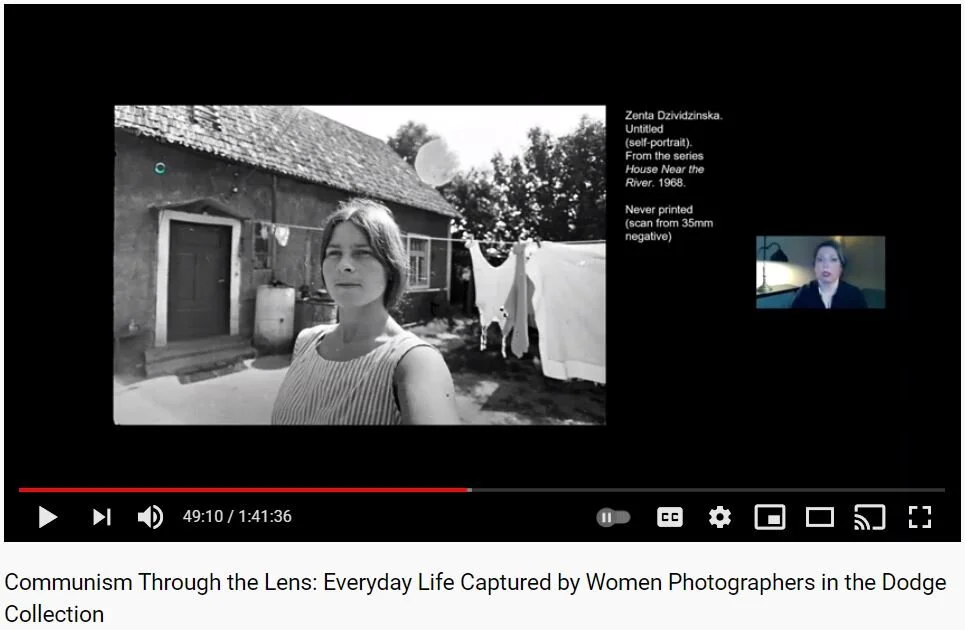
“Zenta Dzividzinska (1944-2011): Photography between art, photo-club, and private diary” is a talk I presented at a roundtable on the occasion of the exhibition celebration and virtual opening reception - Communism Through the Lens: Everyday Life Captured by Women Photographers in the Dodge Collection - at the Zimmerli Art Museum, Rutgers University, on April 29, 2021. The exhibition is curated by Maria Garth.

View the recording of the event on the Zimmerli Art Museum’s YouTube channel here https://www.youtube.com/watch?v=btHF69FZfgA or click on the image below:

I was invited by the exhibition curator, Maria Garth, Graduate Curatorial Assistant (Dodge Fellow) at the Zimmerli Art Museum. The event featured a curator-led overview of the exhibition by Maria Garth, followed by a roundtable discussion with guest speakers and a question-and-answer session with the audience. Guest speakers include Mark Svede, Ph.D., Ohio State University, and myself. The event was introduced by Julia Tulovsky, Ph.D., Curator at the Zimmerli Art Museum, and the discussion was moderated by Jane Sharp, Ph.D., Research Curator at the Zimmerli Art Museum and Professor of Art History at Rutgers University.

The exhibition Communism Through the Lens: Everyday Life Captured by Women Photographers in the Dodge Collection at the Zimmerli Art Museum, Rutgers University is scheduled to be on view virtually from May 1 to October 17, 2021 with the possibility of in-person viewing in the fall, depending on the COVID-19 situation and the related restrictions at the time.

View the virtual exhibition on the Zimmerli Art Museum website.

To learn more about the life and work of Zenta Dzividzinska, please visit the website https://www.artdays.net/.

About the exhibition Communism Through the Lens: Everyday Life Captured by Women Photographers in the Dodge Collection:

Spanning almost the entirety of the Soviet Union’s history from the 1920s through the 1990s, this exhibition of rarely-seen images explores themes of political art, documentary photography, and gender, offering a historical look at how women photographers interpreted life in the communist state. [. . .]

Despite the Soviet Union’s rhetoric of gender equality, women of both generations from all over the Soviet Union shared a range of personal and professional challenges in advancing their careers as photographers.

Bringing together over one hundred and thirty works from the Zimmerli’s Norton and Nancy Dodge Collection of Nonconformist Art from the Soviet Union, including photography books and journals, the majority of which are displayed for the first time, this is the first exhibition at the Zimmerli devoted to photography by women from the Soviet Union. It also presents a survey of approaches to photography to highlight for the first time the central role played by women in redefining photography’s social reach – and expressivity – as perhaps the quintessential modernist medium.
— Zimmerli Art Museum

Zenta Dzividzinska, Untitled, 1965. Gelatin silver print on paper. Norton and Nancy Dodge Collection of Nonconformist Art from the Soviet Union.

See a few slides from my presentation below, and watch the event’s recording on the Zimmerli Art Museum’s YouTube channel here: https://www.youtube.com/watch?v=btHF69FZfgA

Read about the exhibition in The Calvert Journal: “A virtual exhibition celebrates the overlooked legacy of Soviet women photographers” (April 27, 2021): https://www.calvertjournal.com/articles/show/12716/soviet-female-photographers-virtual-exhibition-

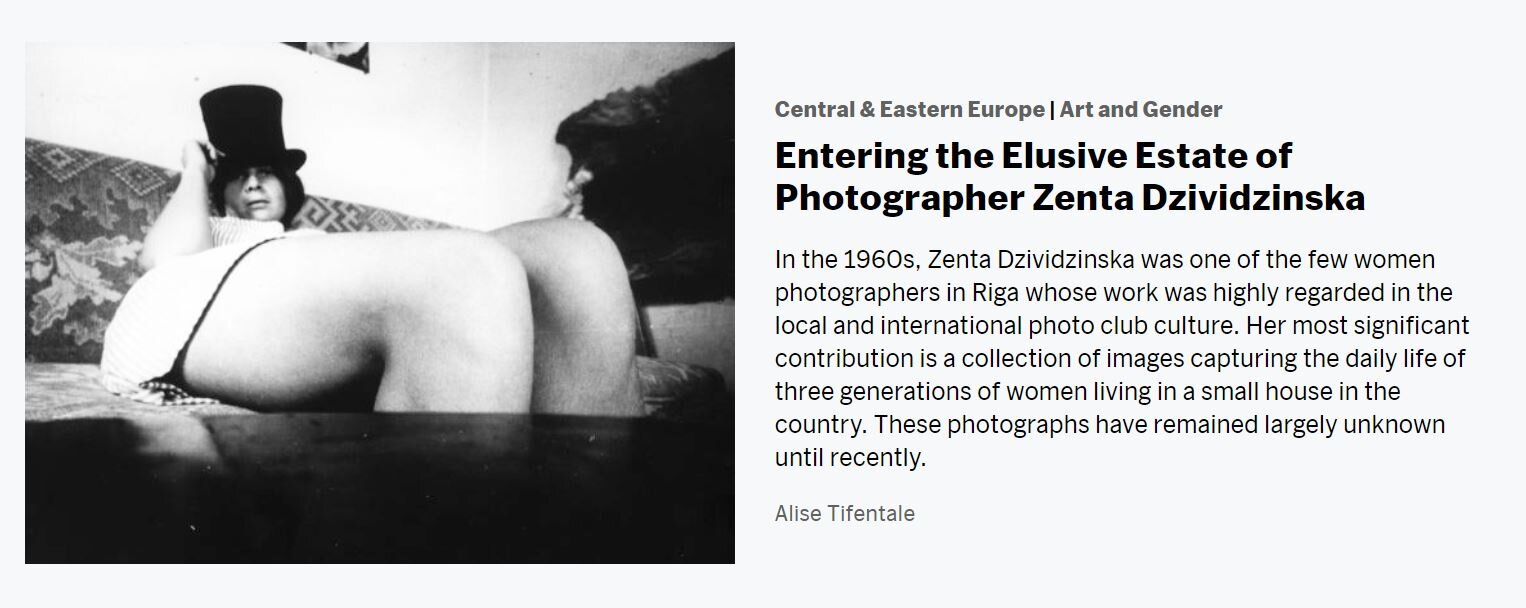
Entering the Elusive Estate of Photographer Zenta Dzividzinska

Tifentale, Alise. “Entering the Elusive Estate of Photographer Zenta Dzividzinska.” MoMA Post, March 24, 2021. https://post.moma.org/entering-the-elusive-estate-of-photographer-zenta-dzividzinska/

New article in the Museum of Modern Art’s online research publication Post. Notes on Art in Global Context, listed in sections Central & Eastern Europe and Art and Gender.

UPDATE: in 2024, this article was included in the anthology Central Eastern European & Diasporic Feminisms (London: Cell, 2024). Find out more about this publication here: https://www.alisetifentale.net/research-blog-at/ceed-feminisms-bibliography

Read the article on MoMA Post website: https://post.moma.org/entering-the-elusive-estate-of-photographer-zenta-dzividzinska/ or download the article PDF here: download article pdf

To learn more about the Latvian artist and photographer Zenta Dzividzinska (1944-2011), please visit the website of her archive and estate, Art Days Forever.

Zenta Dzividzinska. Page from a contact print book. 1965. Latvian National Museum of Art.

Zenta Dzividzinska. Untitled (Self-portrait). From the series House Near the River. 1968.

Abstract:

Art historian Alise Tifentale considers the difficulties of preserving and interpreting the legacy of Latvian artist and photographer Zenta Dzividzinska (1944–2011). In the 1960s, Dzividzinska was one of the few women photographers in Riga whose work was highly regarded in the local and international photo club culture. Her most significant contribution is a collection of images capturing the daily life of three generations of women living in a small house in the country. These photographs have remained largely unknown until recently. This essay highlights the sociopolitical and cultural motives for such neglect and suggests avenues of further research of the artist’s estate.

This essay introduces the life and career of Zenta Dzividzinska or ZDZ (the artist, annoyed by having to spell out her long, Polish-sounding last name, which was rather unusual in Latvia, liked to sign with this abbreviation), focusing on her artistic output of the 1960s and early 1970s. At the center of this body of work is a vast collection of images that she later titled House Near the River, which were made in and around her parents’ home on the outskirts of Iecava, a village less than an hour’s drive south of Riga. During the 1960s, while studying art in Riga and working, ZDZ often visited her parents and extended family there. Later, she returned to the house to live in it permanently with her husband, whom she married in 1969.

House Near the River comprises hundreds of negatives and prints depicting the daily life of three generations of women as it unfolded in and around their small house in the Latvian countryside. Today these images can be viewed perhaps as para-feminist (to use Amelia Jones’s term) because explicitly feminist critique did not emerge in Latvian art until the 1980s.

Zenta Dzividzinska. Page from a contact print book. 1965. Latvian National Museum of Art.

Zenta Dzividzinska. Page from a contact print book. 1965. Latvian National Museum of Art.

Zenta Dzividzinska. Page from a contact print book. 1966. Latvian National Museum of Art.

Is This the Right Time for Landscape Photography?

The essay was written in January and February 2020, just before the COVID-19 outbreak paralyzed our lives, and published in August 2020, just after the most severe restrictions had been lifted and a biennale could take place in Riga, Latvia. Although written just a few months earlier, the essay today seems to belong to some distant time and place, to a world that, likely, will remain only in our memories.

Read more

Brazilian Participation in FIAP, 1950–1965 (São Paulo, 2019)

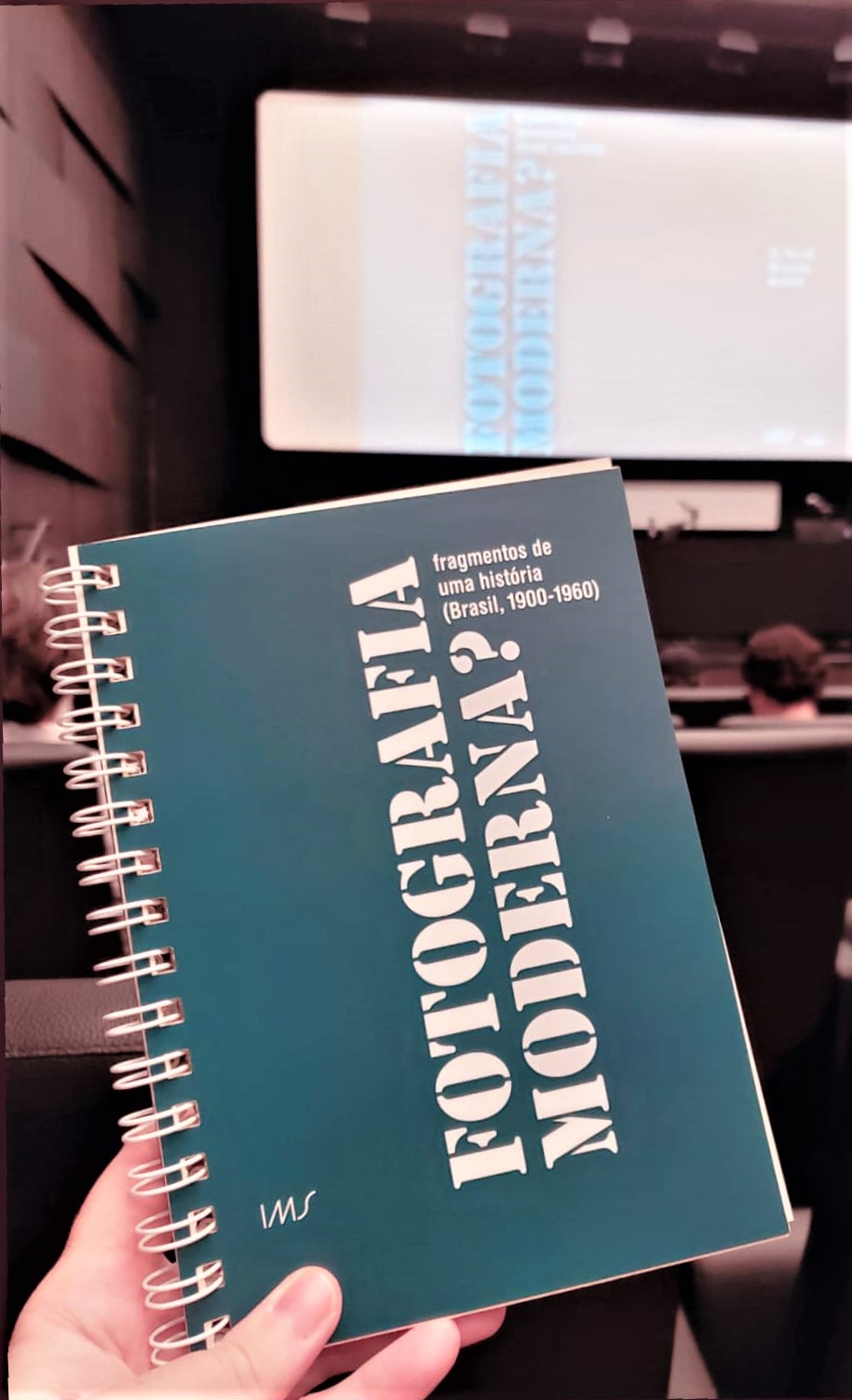
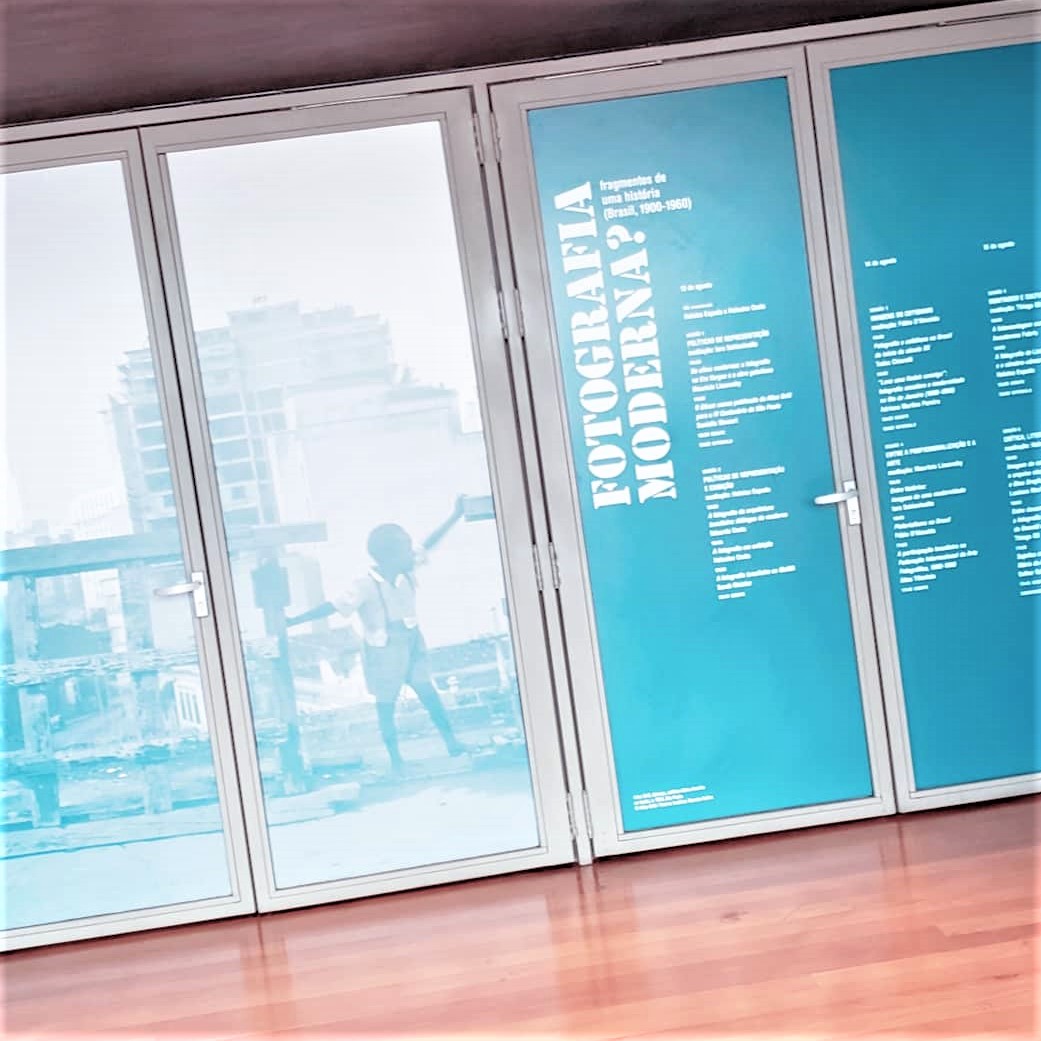
"Brazilian Participation in FIAP, 1950-1965" is a talk I had the honor to present at the seminar Fotografia moderna? Fragmentos de uma história (Brasil, 1900-1960) at the Instituto Moreira Salles (IMS Paulista), São Paulo, Brazil, August 13-15, 2019. The seminar was organized by Helouise Costa and Heloísa Espada.

See the full program of the seminar as well as video recording of all panels within the seminar on the IMS Paulista website: Fotografia Moderna? Fragmentos de uma história (Brasil, 1900-1960)

Abstract of my talk (working version):

“For me, the most moving aspect of looking at a salon catalogue is seeing the names of Brazilians entangled with names of artists from other parts of the world … democratically positioned as equals,” acknowledged José Oiticica Filho (1906–1964) in an article published in Boletim Foto Cine in 1951. A key figure in Brazilian postwar photography, Oiticica Filho is acknowledged as an important experimental photographer, one of the pioneers of modernist photography associated with the São Paulo photo club Foto Cine Clube Bandeirante (FCCB). Little, however, is known about another aspect of his involvement with photography: parallel to his creative work, he compiled extensive data tables pertaining to hundreds of photography exhibitions throughout the world. By doing so, Oiticica Filho established a significant link between Brazilian photographers and the global photo-club culture of the 1950s.

The work of photo clubs revolved around international juried exhibitions (also referred to as salons) selected through open call. During the 1950s, photographers often relied on photo-club salons as their primary regular exhibition venues because the established systems of art museums and galleries welcomed their work only in rare exceptions. The most visible advocate of the global photo-club culture was the International Federation of Photographic Art (Fédération internationale de l'art photographique, FIAP), founded in Switzerland in 1950. Over the following decade, FIAP united and mobilized photo clubs in fifty-five countries in Europe, Latin America, Asia, and Africa, becoming the first post-World War II organization to provide photographers with an institutional space that existed outside the market and that transcended political and ethnic borders.

Brazil was the first non-European country to join FIAP in 1950. The founder and president of FIAP, Belgian photographer Maurice Van de Wyer (1896–1994) was a close acquaintance of Eduardo Salvatore (1914–2006), the founder and president of FCCB. Van de Wyer visited São Paulo and FCCB on a regular basis during the 1950s. While it is not clear whether Oiticica Filho and Van de Wyer ever met in person, Oiticica Filho became an active contributor to the work of FIAP. He published several statistical reports about international salons of photography, based on data he collected from salon catalogues. These reports reveal the geographic reach of the global photo-club culture in the mid-1950s, with hundreds of exhibitions every year in countries across the world. Most active exhibition participants managed to circulate tens and even hundreds of prints at a time in various salons, and among them were FCCB members such as Gertrudes Altschul (1904–1962), Francisco Albuquerque (1917–2000), Ivo Ferreira da Silva (b. 1911), Gaspar Gasparian (1899–1966), Jean Lecoq (1898–1986), and Kazuo Kawahara (b. 1905), as well as Salvatore and Oiticica Filho himself.

Oiticica Filho’s statistical work opens a broader perspective on postwar photo-club culture as a global phenomenon. Data he collected and published make a thriving, transnational field both visible and quantifiable by providing a helpful guide to the otherwise uncharted field of photo-club culture that firmly establishes Brazil as one of its creative centers.

IMS Paulista. Photo: Alise Tifentale.

IMS Paulista. Photo: Alise Tifentale.